


Hoop Belly Ring Buying Guide: What to Know
Summer snuck up on me again. One minute I'm pulling out my old bikinis and the next I'm standing in front of the mirror wondering why I ever let my belly piercing close. If you've been there too, or if you're shopping for your first hoop belly ring and have absolutely no idea where to start, this is for you.
The belly ring market is genuinely confusing. There's a lot of cheap stuff out there dressed up in nice packaging, and it's hard to know what's actually worth wearing on your body versus what's going to turn your skin green by day three. After 10 years of making body jewellery, here's what I actually look for.
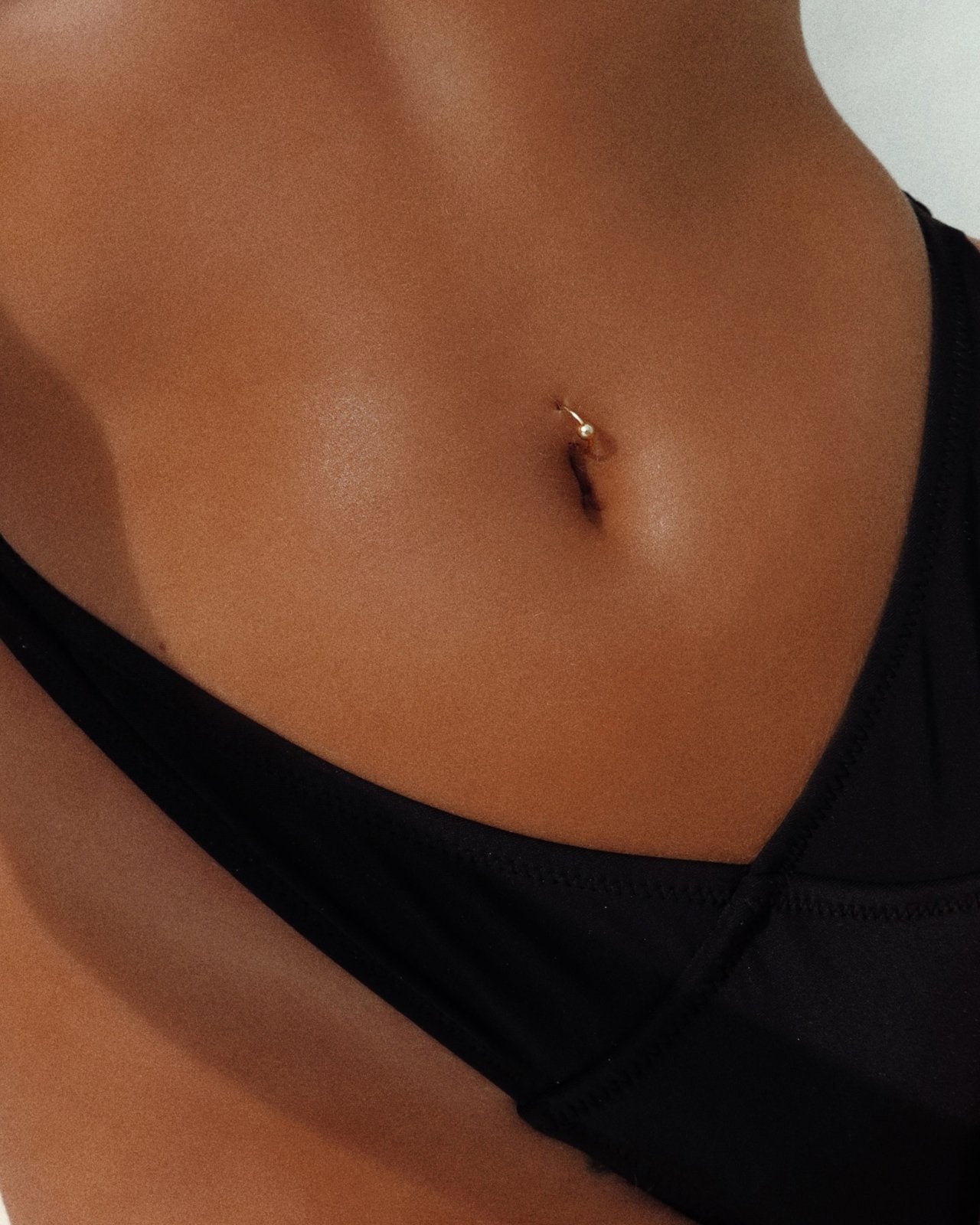
What makes a good hoop belly ring
A hoop belly ring sits differently to a standard dangle style. Instead of a curved barbell with a charm hanging from it, a hoop sits through both holes of the piercing and forms a continuous ring against your skin. It's a cleaner look, a bit more architectural, and honestly more wearable day-to-day than a dangling piece.
But because it's sitting against your skin all day (and potentially in the ocean, in the shower, or under a bikini top), the material matters more than almost anything else.
Material is everything
This is where most cheap belly rings fall apart. Literally. Surgical steel sounds safe until you realise it still contains nickel. Gold-plated sounds fancy until you remember that the gold layer is thinner than a human hair and will rub off within weeks. Then you're left with bare brass sitting against a piercing, which is one of the worst places on your body for a metal reaction.
14k gold-filled is a different story. It's a solid layer of 14k gold that's been pressure-bonded to a brass core. Legally, the gold layer has to make up at least 1/20th of the total weight of the piece, and at 14k that means 58.3% pure gold in that outer layer. It won't flake, it won't rub off, and it won't react with water or sweat the way plating does. For a belly ring specifically, this matters because piercings are sensitive and you really don't want to be irritating them with dodgy metals.
If you want to go deeper on the material question, our guide to gold-filled jewellery covers it properly.
Gauge and fit
Standard belly piercings are done at 14 gauge (written as 14G). This is the most common size and what most belly rings are designed for. Before you buy anything, check your gauge if you're not sure, because going too thin can cause the ring to move around and irritate the piercing, and going too thick won't fit at all.
For hoop belly rings specifically, diameter matters too. Most sit between 10mm and 14mm. A smaller diameter sits closer to the skin and reads more minimal. A larger one gives you that proper hoop moment, sitting away from the navel a little. Neither is wrong, it just depends on your anatomy and the look you're going for.
The closure
Not gonna lie, this is the part nobody talks about and it's so important. A hoop belly ring needs a secure closure that you can open and close yourself without needing a second person and a set of pliers. Segment rings, clicker closures, and captive bead rings all work well. Avoid anything that relies on friction alone to stay closed, because bodies move and rings do too.
Our hoop belly ring pick
We make one hoop belly ring and it's the one I'd wear myself (obsessed). The Hoop Belly Ring in 14k Yellow Gold Fill is $99 and it's designed to go everywhere with you. In the ocean, in the shower, at the gym. The 14k gold-fill construction means it's hypoallergenic, tarnish-resistant, and won't irritate skin that's prone to reacting.
It sits clean and close to the navel, which I think looks really good under high-waisted bikini bottoms or cropped sets where you want just a hint of gold rather than a big dangling charm. If you're team maximalist, you can always layer it with a belly chain over the top. But as a standalone piece, it's exactly what I'd reach for.
You can browse the full belly rings collection here if you want to see everything we have.
How to wear a hoop belly ring
The main thing is making sure your piercing is fully healed before you change to a hoop style. Navel piercings take longer than most people expect, anywhere from six months to a full year, and sometimes longer. If you're still in the healing phase, stick with your original jewellery and come back to the hoop once everything's settled.
Once you're healed, changing a belly ring is pretty straightforward. Clean your hands, open the closure, thread the ring through both holes of the piercing, and close it back up. Do it over a clean surface so you don't lose the closure if it drops.
Honestly, the hoop style is one of the easier belly rings to swap in and out once you get the hang of the closure. Less fiddly than a curved barbell with a tiny top ball that rolls under furniture the second you set it down (trust me on this).
Caring for your hoop belly ring
The good news about 14k gold-fill is that it's genuinely waterproof. You can shower in it, swim in it, and sweat in it. But there are a few things worth knowing to keep it looking its best for years.
- Rinse it with fresh water after swimming in the ocean or a chlorinated pool. Chlorine doesn't damage gold-fill, but it's a good habit.
- Pat it dry rather than leaving it wet. Just because it's waterproof doesn't mean you need to test that harder than necessary.
- Avoid applying sunscreen or body oils directly onto the ring. Put those on first and let them absorb before the jewellery goes on.
- Clean it occasionally with a soft cloth. A quick buff is all it needs to keep that warm gold glow.
For a deeper dive on caring for gold-fill pieces, this post covers everything.
Frequently asked questions
Can I wear a hoop belly ring in the ocean?
Yes, if it's 14k gold-fill. It's designed to handle salt water, fresh water, and chlorine. Just rinse it afterwards.
How do I know if my piercing is healed enough to wear a hoop?
No redness, no discharge, no tenderness when you press around it. If any of those are present, wait. When in doubt, check with the piercer who did the original piercing.
Will a hoop belly ring irritate my skin?
Not if it's 14k gold-fill or solid implant-grade titanium. Those are the two safest options for piercings. Our gold-fill ring is nickel-free and hypoallergenic, so it's safe for sensitive skin. If you've had reactions to jewellery before, this post on jewellery for sensitive skin is worth a read.
Is a hoop belly ring harder to put in than a standard curved barbell?
It's different, not harder. The closure takes a little getting used to, but once you've done it a few times it's actually faster than screwing on a tiny top ball in bad lighting.
How long do hoop belly rings last?
A 14k gold-fill piece, looked after properly, should last years. Gold-plated pieces are a different story, the gold layer is too thin to hold up to the friction and moisture of a belly piercing, and most start to look worn within a few months.
If you're weighing up materials more broadly, the belly rings guide goes into more detail on what actually holds up.
So, are you team minimal hoop, or do you layer everything at once? I'd love to know how you're wearing yours this summer.
P.S. If you're buying a belly ring as a gift, grab the deluxe gift box at checkout. It makes the whole thing feel really considered, even if you ordered it at midnight.
